
In an informed scientific decision, Heat Biologics new lung cancer trial to include checkpoint inhibitors; Long-term vision sees possible increase in efficacy, with toxic side effects reduced; Combining cancer vaccines with checkpoint inhibitors is gaining clinical momentum; Whether both modalities together lead to success hangs in the balance; in the meantime, Heat may need cash; Change in clinical trial design is intended to boost shareholder value through better outcomes
NEW YORK, NY / ACCESSWIRE / September 18, 2015 / Heat Biologics (HTBX:NASDAQ), in a move motivated by delivering the best clinical results in treatment for non-small cell lung cancer (NSCLC), made an informed scientific move to follow a new initiative. Its lead drug for NSCLC, HS-110 will be used together with nivolumab, brand named Opdivo and marketed by Bristol-Myers Squibb. Opdivo, proving to be a powerful checkpoint inhibitor, has risen rapidly in clinical opinion since approval last year to become a drug of choice for NSCLC, after receiving the FDA’s coveted Breakthrough Therapy designation due to stunning efficacy and extension of life.
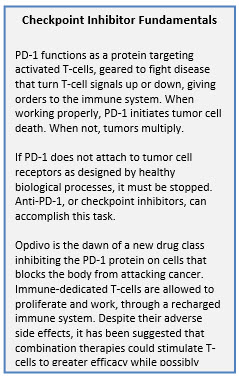
Heat is the first to combine a cancer vaccine with a checkpoint inhibitor for NSCLC, although others are exploring hopes that a multi-based therapy would increase efficacy without bad side effects seen with PD-1 targeted drugs. Research in the last several years points to a synergy between the two modalities: in 2012, peer-reviewed science journal OncoImmunology reported safety and “encouraging clinical activity” with Bristol-Myers Yervoy and a vaccine for prostate cancer. Musings on a resurrection of cancer vaccines, several of which failed during clinical trials, put faith of success on combinations with checkpoint inhibitors. Case in point is GlaxoSmithKline’s (GSK:NYSE) MAGE-A3 vaccine for NSCLC that flopped in Phase III trials, and now the pharma giant thinks combining cancer vaccines with anti-PD-1 therapy may aid in stopping a tumor’s ability to escape detection from the immune system.
The first subject has enrolled in Heat’s 18-patient Phase Ib trial, named DURGA after the seven-armed Hindu goddess worshipped as the root cause of creation – Heat has cleverly built into its study design the ability to add study ‘arms’ testing new immunotherapies as they become available without full application to the FDA. Endpoints in DURGA include safety, immune response, overall response rate and progression-free survival.
Cancer cells are tricky. Our body’s immune system – antibodies, lymphocytes, T-cells and B-cells – sometimes do not recognize cancer as foreign like they would microbes, and a strong defense is not mounted. Complicating matters, tumors produce on their surface biological markers that confuse the body, weakening otherwise effective resources. Cancer cells mutate, making immune fighter cells work harder, and cancer cells emit chemical messages that suppress immune response. As a result, cancer vaccines, designed to treat existing disease by boosting the immune system to stop cancer growth through T-cell stimulation or to kill tumors, are gaining great attention. Combination with anti-PD-1 therapy, or checkpoint inhibitors, whose blend might accentuate each other’s power, could push immunotherapy forward in ways not anticipated 10 years ago.
The news of a fresh trial using checkpoint inhibitors caught investors by surprise, despite past data that pointed towards this change as the company waited for approval of Opdivo for NSCLC. In February, Heat showed preclinical work with its therapeutic platform, ImPACT, that revealed positive results when incorporated with other types of T-cell stimulators. Later, Heat found that patients in its trial for bladder cancer using HS-410 did better when low levels of lymphocytes, another key component of human immunity, were detected, leading researchers to conclude that cancer vaccines could boost T-cell production and, in combination with checkpoint inhibitors, increase the otherwise poor numbers of responders with checkpoint inhibitors alone, currently 30%-40% of patients. When Opdivo approval for lung cancer was announced and the drug available, DURGA began.
NewLink Genetics (NLNK:NASDAQ), in Phase IIb trials with a vaccine for advanced lung cancer in conjunction with anti-cancer agent docetaxel, publicly mulled over the idea of using a checkpoint inhibitor instead but nothing yet has been launched. With enrollment in DURGA underway, Heat is ahead of NewLink as the first biotech to use a vaccine with a checkpoint inhibitor in lung cancer. If successful, Heat would have a ‘first competitive advantage’ in becoming standard of care.
I recently met with Jeff Wolf, CEO of Heat Biologics, who trusts the clinical course Heat has taken is the right one, and backs the theory that cancer therapy is on a new path. Mr. Wolf told me “We are the first company out of the box testing a combination of cancer vaccines with a checkpoint inhibitor for lung cancer. There are tremendous synergies between our vaccines and anti-PD-1 therapy as shown with data we presented at the Keystone Symposia last February. The environment is changing for lung cancer. All patients will go from monotherapy to a combination.” He is not alone in this opinion.
In May, interim HS-110 data from Phase II disclosed at the American Society of Clinical Oncology (ASCO) suggested that PD-1 cell receptors, which stands for programmed cell death and implicated in tumor regression, pointed toward the vaccine potentially stimulating T-cell activity and growth in numbers in response to HS-110. Heat viewed this as support for shifting clinical focus in its NSCLC trial and in addition to Opdivo, plans to study Merck & Co.’s (MRK:NYSE) Keytruda, another potent checkpoint inhibitor, with HS-110 when Keytruda gets approval for lung cancer (Keytruda received Breakthrough Therapy designation from the FDA last October, stressing clinical recognition of the strength of this drug class). Heat assured investors in a recent conference call that its timeline for producing data from the HS-110/cyclophosphamide study will not veer from its original objective and expects to release six-month progression free survival results by year-end 2016. Results will not be wasted and used to educate researchers.
Cancer vaccine immunotherapy collaborations have been escalating. Last March, Bristol-Myers struck a $1.03 billion deal with Danish biotech Bavarian Nordic A/S (BVNRY:Other OTC) to combine Bristol-Myers’ anti-PD-1 Yervoy with Nordic’s Prostvac in a Phase II trial for metastatic prostate cancer. In August 2015, AstraZeneca PLC (AZN:NYSE) committed $700 million to Inovio Pharmaceuticals (INO:NASDAQ) for use of its vaccine in head and neck cancer with Medimmune’s pipeline of immunotherapy candidates for the same condition, under the belief that synergies between the two will enhance effectiveness in tumor death while curtailing side effects.
Other arrangements in the cancer vaccine/anti-PD-1/regulatory T-cell arena include Aduro Bio Tech (ADRO:NASDAQ) with Bristol Myers for pancreatic cancer; Incyte Corp. (INCY:NASDAQ) with Bristol-Myers, Merck, Roche and AstraZeneca (Incyte recently pulled in a $795 million deal with China-based Jiangsu Hengrui Medicine for work with its own checkpoint inhibitor); and Advaxis, Inc. (ADXS:NASDAQ) with AstraZeneca for HPV-related cancers. This is only a sampling of the partnering frenzy taking place over the last year that includes collaborations among the partners themselves.
Cancer drugs, and cancer vaccines, are a huge market, growing every year. Global cancer drug sales reached $100 billion in 2014, predicted to rise to $147 billion by 2018. Cancer vaccines are expected to comprise a market of $4.3 billion by 2019, according to recent data, up from $292 million in 2011.
Lung cancer is lethal and expensive. Roughly 195,000 suffer from NSCLC each year, with a mortality rate of almost 70%, amounting to around 1.5 million deaths per annum. Survival is sketchy, depending on the stage cancer is detected – at the most deadly stage, Stage IV, five-year survival is 2%.
The worldwide NSCLC drug market was estimated at $4.3 million in 2009, expected to grow around 5% per year on a compounded annual basis, to $6.9 billion in 2019. Major markets comprise the US, UK, Germany, France, Italy, Spain and Japan. At the time of this estimation, only new anti-cancer therapies, including targeted drugs like monoclonal antibodies using angiogenesis and other methods, were considered. Checkpoint inhibitors Opdivo and Keytruda were excluded, as they were not yet approved. Things have changed – considering analysts’ estimates for Opdivo in NSCLC could contribute up to $1.5 billion per year at peak Bristol-Myer sales, and up to $5 billion if non-squamous NSCLC is approved, these same analysts believe the PD-1 drug class dollar amount is upwards of $21 billion by 2022.
Merck Receives FDA Breakthrough Therapy Designation for KEYTRUDA(R) (pembrolizumab) in Advanced Non-Small Cell Lung Cancer
Proof of safety and tolerance in combination trials would help solve another big drawback to checkpoint inhibitors – toxicity to normal tissue. Opdivo side effects include abnormal liver function, lung, large intestine and pituitary gland inflammation and intense stomach pain. Keytruda has been shown to lead to lung inflammation, intestinal holes and kidney failure. By contrast, inflammation, redness or rash at the injection site are the only adverse side effect seen with cancer vaccines, and bears true with HS-110’s own observations.
Heat Biologic investment risks, besides its small-cap status, continual need for money (cash as of June 30 was $19.3 million, annualized burn rate $17.7 million, long-term debt $3.9 million, although capitalization table is clean with debt to equity under 30%), and regulatory hurdles include potential pitfalls in its new clinical pathway: Opdivo is currently approved only for squamous NSCLC, a less-common feature of lung cancer, which could hinder enrollment but the National Cancer Comprehensive Network (NCCN) that makes guidelines for treatment permits Opdivo in enough forms of lung cancer to ensure Heat has reimbursement for its combination trials, and a flow of patients. Adding HS-110 to checkpoint inhibitors may not reduce adverse side effects and the question of greater efficacy in the combination remains. Heat may decide to begin a new bladder cancer study, the original with a well-known drug now in middle phase, using checkpoint inhibitors as recent clinical results suggest. This could confuse investors as it did with HS-110 and hurt the stock. On the plus side, if clinical trials pan out, the combination of HS-110 and Opdivo may be eligible for the FDA’s Breakthrough Therapy designation, like Opdivo itself had accomplished.
Plans to explore using PD-1 inhibitors with HS-110, and possibly HS-410 were put in place months ago and Heat is interested only in producing the best clinical results for medicine and shareholder value by redirecting resources towards the most optimal outcome. Heat’s management, smart and clinically savvy, now provides a way to combine its drug for NSCLC, already shown to be safe and effective, with one of the 21st century’s wonder drugs to potentially bring cancer medicine to a new age.
About Small Cap Forecasting, Inc.
Sharon di Stefano has spent 20 years as an analyst, beginning her career at Smith Barney, Harris Upham & Co. specializing in medical devices, pharmaceuticals, healthcare information technology, and bio-pharmacology. Ms. di Stefano had also served as Senior Venture Officer for the Edison Innovation Fund, implemented through the New Jersey Economic Development Authority that provided funding for early-stage life sciences companies. Industry experience includes laboratory research for Johns Hopkins Hospital and the Department of Defense. Ms. di Stefano received a Master’s of Science degree, in Business, from Johns Hopkins University in 1986, and a Bachelor of Arts from the University of Delaware in 1984 with a minor in biology.
Media contact:
Jackie Rodriguez
646-430-5783
SOURCE: Small Cap Forecasting, Inc.
ReleaseID: 432070
